Part 1: Why Open Source Matters
Open Source as Differentiator
"If a developer can pick software that is also open source, it's just better."
— James Hawkins, PostHog
Why developers prefer OSS:
- Code is inspectable
- Can verify claims
- Can contribute/customize
- No vendor lock-in fears
- Community validation
Open Source GTM
The master plan pattern (from Resend):
- Launch open-source project around [domain]
- Establish yourselves as experts around [domain]
- Launch SaaS around [domain]
Part 2: Getting Your First 1000 Stars
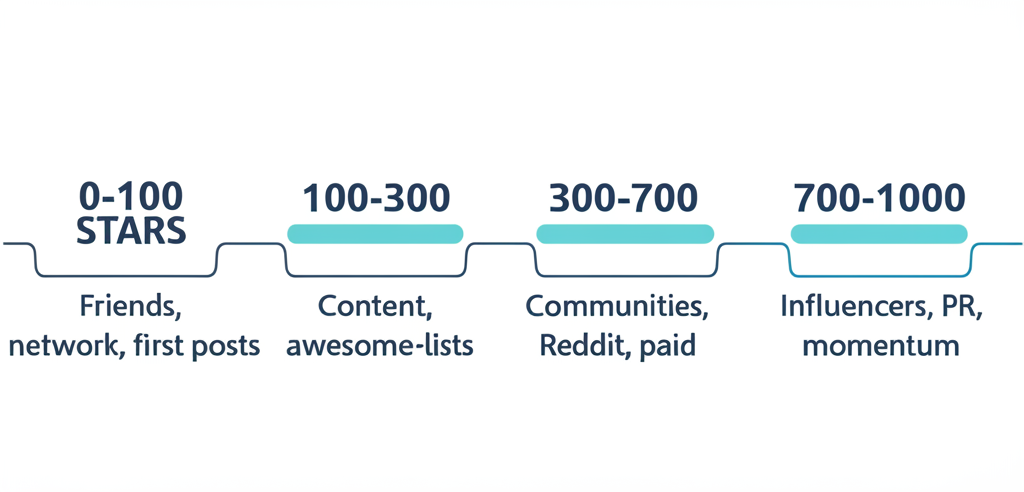
Prerequisites: Repo Health
Before marketing, ensure:
- Clear description of what your tool does
- Well-structured README: What you do, code snippets, UI gifs
- Docs site you want to send people to
The First 100 Stars: Artificial Growth
Kick-off sources:
- Friends and family message
- Neighbors in shared office space
- Show it off (free) at conferences
- First launch announcements on social
Beyond 100: Organic Growth
Content creation:
- Present the tool directly and indirectly
- Listicles ("10 tools for X")
- Tutorials using your tool
Content distribution:
- Syndication (Medium, Dev.to)
- Reddit and socials
- Your own blog (SEO)
GitHub lists:
- PR to get on every relevant list
- awesome-* lists
- curated collections
Communities and dark social:
- Slack, Discord, Reddit
- WhatsApp groups
- LinkedIn and Facebook groups
Paid campaigns:
- Ethical Ads
- Reddit (subreddits)
- Twitter (keywords)
Influencers:
- List relevant influencers
- Find collaborative opportunities
- Reach out directly
Part 3: The GitHub PR Growth Loop

How It Works (Snyk Example)
- New user signs up for Snyk
- They connect their GitHub account
- Snyk finds vulnerabilities in their repos
- Snyk-bot creates branded PR to fix them
- Other devs in org see and interact with PR
- Some follow links to check out Snyk
- Some sign up for Snyk
Why it's powerful:
- Uses existing developer workflow
- Visible to entire team
- Natural, not intrusive
- Creates internal awareness
Designing Growth Loops
Key elements:
- Triggered by natural user behavior
- Visible to other potential users
- Provides value (not just exposure)
- Easy to act on
Part 4: GitHub Search Optimization
How GitHub Search Works
Ranking factors:
- About section: Keywords matter, but so does keyword density
- Topics: Extend search term coverage
- Stars: Social proof signal
- Activity: Recent commits matter
Optimization Tactics
About section:
- Put keywords in About
- Keep it as short as possible
- % of keywords to all terms matters
Topics:
- Use one-word topics
- Extend what you used in About
- Cover more search terms
Part 5: README Strategy
README Structure
For open source project launch (from Resend):
Spend 1 week on the library, 3 weeks on website and README.
Key sections:
- What it is (one sentence)
- Why it exists (problem it solves)
- Quick start (copy-paste code)
- Features (visual if possible)
- Installation
- Usage examples
- Documentation link
- Contributing guide
- License
Making README Visual
- GIFs showing tool in action
- Screenshots of UI
- Architecture diagrams
- Badges (build status, stars, etc.)
Copy-Paste is King
"As a developer, I want to get it up and running now. What can I copy-paste and get started as quickly as possible?"
Make installation and first use trivially easy.
Part 6: Growing Traction
Launch Tips (from Resend)
Goal to communicate: "I get the use case, I get how to inject it to my project, and scale as the project/usage grows"
Information flow priorities:
- Readme sections
- How easy it is to get started
- How to ask for help
- What code to copy-paste
Continuous Growth Tactics
Retargeting experiment: Reach out to stargazers of similar repos. Just ask them to try yours.
Celebrate milestones: Share milestones publicly. More people join a moving train.
Shamelessly promote others: Promote related projects (and yours with it).
Use case testimonials: Reach out to bloggers in your space. See if they'd try your tool and write about it.
Part 7: Community and Contributors
Building Contributor Community
Make contributing easy:
- Good first issues labeled
- Contributing guide clear
- Fast PR reviews
- Welcoming to newcomers
Maintaining Momentum
Regular updates:
- Changelog visible
- Release announcements
- Roadmap public
Community engagement:
- Respond to issues
- Thank contributors
- Feature community projects
Part 8: Open Source Monetization
Models That Work
- Open core: Core open source, enterprise features paid
- Cloud hosting: Self-host free, managed cloud paid
- Support: Open source free, paid support
- Dual license: Open source for OSS, commercial for commercial
Positioning Open Core
From Retool's clarity:
- "Cloud (we host)"
- "Self-hosted (you host)"
Make the difference crystal clear.
Self-Hosted in Navigation
n8n tactic: Put self-hosted deployment guidance in docs tab dropdown.
This frontloads a key differentiator where developers look.
Part 9: Measuring Open Source Success
Vanity vs Valuable Metrics
Vanity (but still useful):
- Star count
- Fork count
- Contributor count
Valuable:
- Active users
- Issues resolved
- Community contributions
- Conversion to paid
Star vs Usage
Stars don't equal usage. Track:
- Downloads
- Active installations
- API calls (if applicable)
- Community activity
Part 10: GitHub Features for Marketing
Sponsors
- Enable GitHub Sponsors
- Visible social proof
- Revenue source
Discussions
- Community Q&A
- Feature requests
- Show me what you built
Pages
- Host documentation
- Landing pages
- Showcase sites
Actions
- Demonstrate your tool
- Template workflows
- Integration examples
Quick Reference: Open Source Checklist
Repo Foundation
- Clear, concise About
- Comprehensive README
- Good first issues labeled
- Contributing guide
- License chosen
Growth
- Submitted to relevant lists
- Social media presence
- Community channels set up
- Milestone celebrations planned
Conversion
- Clear path to paid product
- Self-hosted vs cloud clear
- Enterprise features documented
- Support options visible
Resources & Further Reading
Open Source Strategy
- Business of Open Source Podcast — Emily Omier (OSS commercialization)
- Monetizing Open Source — Kelsey Hightower
- Working in Public: Making and Maintenance of OSS — Nadia Eghbal
GitHub Marketing
- How to Write a GitHub README — Markepear
- Detailed Creative Playbook for GitHub Stars — Dev.to
- Prisma README Example — Best-in-class README
Growth Case Studies
- Growing Resend's Open Source Traction — Zeno Rocha (Resend CEO)
- PostHog's Open Source GTM — James Hawkins
- Snyk SEO Growth Loop via GitHub — Ben Williams
Tools
- Awesome Lists — Getting on relevant lists
- GitHub Star History — Track star growth